

For decades, the “three Rs”—reading, writing, and arithmetic—formed the bedrock of a solid education. If you could articulate a thought on paper and calculate your taxes, you were considered literate enough to navigate the professional world. However, as we move through 2026, a fourth pillar has solidified: programming literacy. It is no longer just a niche skill for software engineers; it is becoming as fundamental as the ability to construct a clear sentence. We are living in an era where digital fluency determines one’s ability to participate in the global economy.
The digital landscape has shifted from being a place we visit to the environment in which we live. Whether you are studying sociology, business, or biology, the data that drives these fields is written in code. Relying solely on pre-packaged software is like being able to read but not write; you can consume what others have created, but you cannot create your own tools or manipulate information to suit your specific needs. This gap is precisely why many university students now seek programming help to bridge the divide between theoretical concepts and the practical code required to execute them. Understanding the “under the hood” mechanics of technology allows students to move from being passive users to active creators.
Table of Contents
The Shift from Consumer to Creator
In the early days of the internet, being “tech-savvy” meant knowing how to navigate a browser or format a document. Today, that definition has evolved. Literacy now implies an understanding of the logic that governs our digital interactions. When a student understands the basics of Python or JavaScript, they aren’t just learning a language; they are learning a systematic way of thinking. This transition is vital because the modern workforce values those who can automate their own workflows rather than waiting for an IT department to build a solution for them.
Computational thinking—the ability to break down a complex problem into smaller, logical steps—is the true value of programming. This skill is directly transferable to traditional writing. Just as a good essay requires a logical flow, a clear thesis, and supporting evidence, a good program requires clean logic, efficient structure, and functional output. When you debug a piece of code, you are essentially “proofreading” your logic. This iterative process of trial and error builds a level of mental resilience that is incredibly beneficial for undergraduate students facing high-pressure academic environments.
The Linguistic Architecture of Code
Many people view programming as a branch of mathematics, but in reality, it is much closer to linguistics. Coding involves syntax, grammar, and vocabulary. The primary difference is that the “audience” is a computer rather than a person. However, the goal remains the same: the clear and unambiguous communication of an idea. By learning to code, students improve their ability to be precise in their native language as well. They learn that every “comma” and “bracket” matters, a habit that translates into more meticulous and professional academic writing.
As we look toward the future of professional communication, the “hybrid” professional is the most sought-after candidate. This is someone who can write a compelling marketing copy while also understanding how the underlying algorithm will distribute that content. They are the individuals who can bridge the gap between human needs and machine execution. In this context, programming is not replacing writing; it is augmenting it, providing a new set of tools to express complex, data-driven ideas.
Data as the New Narrative
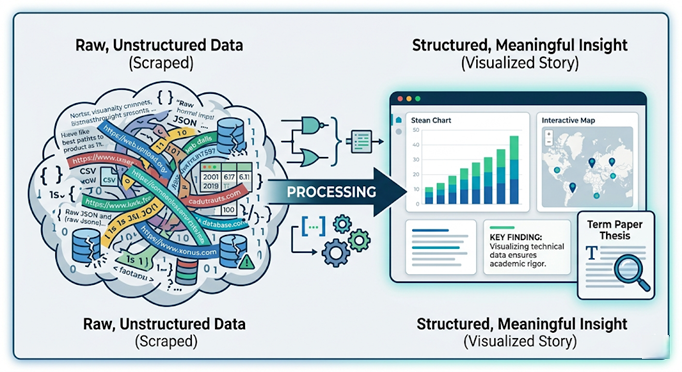
In fields like journalism and marketing, the “story” is increasingly found within massive datasets. A writer who can write a script to scrape data or use SQL to query a database has a massive advantage over one who cannot. They can find original insights that aren’t visible to the naked eye. This ability to “interrogate” data is a form of digital investigative journalism that is becoming standard in top-tier professional circles.
| Literacy Type | Traditional Writing | Programming Literacy |
| Primary Medium | Paper, Digital Documents, Blogs | Code Editors, IDEs, Notebooks |
| Core Objective | Expressing ideas and emotions | Solving problems through logical steps |
| Typical Output | Essays, Reports, Narrative Articles | Scripts, Applications, Data Models |
| Internal Logic | Rhetorical Structure & Style | Algorithms, Syntax, & Efficiency |
| Review Process | Peer Review & Proofreading | Debugging, Testing, & Optimization |
This intersection of data and narrative is particularly evident in long-form academic research. Crafting a high-level thesis today often requires a blend of qualitative analysis and quantitative data processing. Because this workload can be overwhelming, the experts at MyAssignmenthelp suggest that students treat their research as a multi-stage project. For those struggling to synthesize these complex technical findings into a cohesive academic paper, getting professional help with term paper development can ensure that the technical data is presented with the necessary academic rigor and clarity. This support is crucial for students who have the technical data but struggle with the formal presentation required by university boards.
Computational Thinking in the Humanities
One might argue that a philosophy major or a history student has no need for code. However, the “Digital Humanities” is one of the fastest-growing sectors in academia. Historians use code to map ancient migrations, while linguists use natural language processing to track how languages evolve over centuries. Even in the creative arts, “generative art” and digital installations require a baseline understanding of how software interprets creative intent.
When you learn to code, you stop seeing technology as a “black box” that magically produces results. You begin to understand the biases inherent in algorithms and the limitations of software. This critical perspective is vital for undergraduate students who will soon be the decision-makers in a world governed by automated systems. If you don’t understand how an algorithm is built, you cannot effectively critique the results it gives you. This is the new form of media literacy.
The Democratization of Innovation
In the past, building a business or launching a global campaign required a massive team of specialists. Today, a single student with a laptop and a basic understanding of programming can build a prototype, launch a website, and reach thousands of people. This democratization of innovation means that the “barrier to entry” for starting a project has never been lower. However, the “barrier to success” is still high, requiring a sophisticated blend of technical skill and traditional communication.
For the modern undergraduate, this means that the projects they work on in university aren’t just for a grade; they are potential portfolio pieces for their future careers. A history paper that includes a self-built interactive map, or a business report that includes a custom data visualization tool, stands out far more than a standard text-only submission. Programming literacy gives students the “superpower” to visualize their arguments in ways that were previously impossible.
Breaking the “Barrier of Entry”
The most common fear students have is that programming is “too math-heavy.” While certain types of development—like graphics engines or high-frequency trading algorithms—require advanced calculus, basic programming literacy is more about linguistics and logic than it is about numbers. It is about understanding the “grammar” of a language and using it to give instructions to a machine. If you can follow a complex set of instructions to assemble furniture, you can learn to write a script.
Modern education is moving toward a model where coding is integrated across the curriculum rather than being siloed in the Computer Science department. The goal is not to turn everyone into a full-time software developer, but to ensure everyone is “code-literate.” This means being able to read a script, understand its purpose, and perhaps make small modifications to solve a specific problem. It’s about becoming a “power user” of the digital world.
Conclusion: The Competitive Edge in 2026
As the job market becomes increasingly competitive, the ability to speak the language of machines provides a significant edge. It signals to employers that you are adaptable, logically minded, and capable of operating in a tech-driven environment. We are no longer in an era where “not being a computer person” is an acceptable excuse in the professional world. Technology is the infrastructure of modern life, and programming is the language that builds that infrastructure.
Writing remains the tool we use to communicate with humans, to persuade them, and to move them emotionally. Programming is the tool we use to communicate with the systems that run our world. To be truly literate in the current age, you need to be able to do both. By embracing code as a form of modern writing, students empower themselves to not only understand the world but to actively shape it.
FAQ: Programming & Academic Success
Q.1: Do I need to be a math genius to learn basic programming?
Not at all. Basic programming literacy is centered on logic, sequence, and problem-solving. If you can organize a logical argument for an essay or follow a complex recipe, you already possess the foundational skills needed to learn how to code.
Q.2: How can coding skills help me if I’m a non-STEM major?
Coding allows you to automate repetitive tasks, such as gathering research from multiple websites, organizing large sets of bibliography data, or creating custom charts. It also sharpens your analytical thinking, which helps in every academic discipline.
Q.3: Is it worth learning to code if AI can write code now?
Yes, perhaps even more so. You need to understand the logic of code to verify, debug, and improve what an AI generates. Think of it like a calculator: you still need to understand math to know if the calculator gave you the right answer for the right reason.
Q.4: How do I balance learning technical skills with my heavy course load?
Start small. You don’t need to learn an entire language in a month. Focus on small “scripts” that solve immediate problems in your studies. Many students also find that working with experts or mentors can significantly speed up the learning process and help clarify difficult concepts.
Q.5: Can I mention my coding hobby on a resume for a non-tech job?
Definitely. It shows that you are a self-starter, digitally fluent, and have a logical approach to problem-solving. These are “transferable skills” that are highly valued in management, marketing, and administrative roles.
About The Author
I’m Ruby Walker, an academic consultant and technical education strategist at MyAssignmenthelp. With a background in integrating digital tools into the modern curriculum, I focus on helping students navigate the intersection of complex programming logic and high-level research writing.

