

Construction has always had a contentious association with permanence. Every structure aspires to longevity, but almost any infrastructure construction project requires at some point to be modified, repaired, expanded, or replaced through equipment like the skid steer loader.
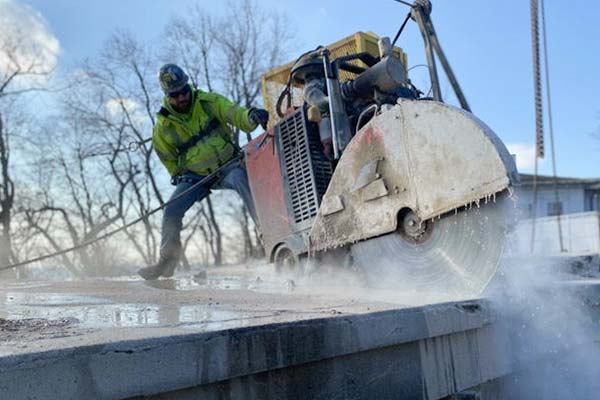
There is one moment during that cycle of building and re-building when cutting comes into play- a process which is both deliberate and technical. Asphalt, concrete, stone, terrazzo, industrial flooring systems- there is nothing that gets installed without an intention to be cut at some point in time. Joints have to be provided. Sections get damaged and need to be removed. Pavement has to provide access to utility corridors. Floor surfaces have to be prepared for over-layers. A flooring saw is one such piece of equipment.
It is impossible to understand flooring without taking into account the entire surrounding machinery that plays a much bigger role in the efficiency of a project than the saw itself.
The Supporting Machine Nobody Talks About
But before talking about the saw, we should mention a very interesting machine- the skid steer loader. There is hardly any other machine that has changed the face of construction sites as significantly as the skid steer loader has. Its compact size, along with its incredible versatility, allowed it to serve not only as demolition or construction equipment, but also as a material carrier and transport.
In floor and pavement restoration, contractors often use skid steers to remove the debris, transport the aggregate, remove cut sections, and ensure smooth flow of operations for several crews. The saw provides the cut, but the rest of the operation requires efficient handling of the materials in and out of the work area.
The importance of this point is especially noticeable in an urban environment, where construction site areas are defined not by the machines’ sizes, but by the existing structures around.
Why Flooring Saws Exist in So Many Forms
A wide range of equipment falls under the category of the flooring saw. Cutting through a warehouse slab and an airport runway represents two entirely different tasks. Thickness of material, density of reinforcement, cutting depth, access, and production schedule are among the considerations for the equipment choice.
Walk-behind saws are still popular among the tools used for common slab cutting due to their portability and simplicity of use. The ride-on saw is used for large paving projects where production becomes a primary concern. Special saws that utilize diamond blades are used to cut reinforced concrete, while abrasive saws could be preferred for cutting asphalt.
Technical innovations brought laser-guided cutting, automatic control of cutting depth, vibration reduction systems, and improved water management systems among other developments. All of those are a part of the growing emphasis on precise construction.
Specs in construction became stricter. The tolerances were reduced, and the quality of the surface had more requirements. Therefore, the saws are working today in conditions that were considered excessive some decades ago.
The Relationship Between Paving and Cutting
Flooring saws do not work alone in most cases. The surfaces that the saws are cutting come from another source in the construction process, which involves highly specialized paving equipment. One of the most important inventions that took place in modern infrastructure construction is the introduction of the slipform Paver.
Slipform paving technology completely changed the process of building large concrete surfaces. Instead of using forms to contain the concrete in its desired shape, slipform pavers continuously shape the material while moving along a predetermined path.
Implications of that go far beyond the improvement of productivity. Roads get smoother, more consistent, and geometrically accurate. It takes less labor to complete such a project. Today, large projects that once required manual intervention can be built with great precision with the help of automated paving technology.
Market Demand and Equipment Investment
The construction equipment market has its share of indications of trends in the industry. The growing popularity of skid loaders for sale is indicative of several trends which are interrelated in some way. The development of urban infrastructure continues at full speed. Utility improvements are gaining momentum throughout many areas. More and more contractors are looking for equipment that will be capable of doing a number of tasks without needing to organize a large fleet for transportation.
The logic behind this is pretty straightforward. A piece of equipment that can carry out loading tasks in the morning hours, demolition in the afternoon, and help with site clean-up by the end of the working day provides an advantage in terms of flexibility of application, which can hardly be provided by specialized equipment.
In many cases, the lifecycle is taken into consideration when it comes to the decision-making regarding purchasing new equipment. Fuel economy, maintenance intervals, compatibility with various attachments, transportation needs, and resale are no less important than the price tag.
What Makes the Flooring Saw Outstanding?
In search of the best flooring saw, you have to take into account several factors beyond price. Manufacturers advertise horsepower capabilities of their saws. In marketing materials, the cutting depth of the saw is mentioned. Blade speeds and productivity are featured in the product brochures. But, in fact, there is another set of parameters that matter for the experienced contractor.
Blade stability, weight distribution, water supply uniformity, ergonomics, and frame rigidity matter in some way. There is every chance that the saw that is good for the polishing of the concrete floor will not do the job well on the highway rehabilitation work.
The saws are used as elements of the system rather than being bought individually. Blade, its maintenance, operator’s skills, and operating conditions all matter.
Infrastructure Expansion and the Future of Paving
All types of infrastructure development worldwide change the dynamics of machinery demand. With the growth of population figures, improvement of logistics and transportation, and urbanization of cities, more and more emphasis is put on large-scale paving solutions. This is why numerous attempts are made to get slip form pavers for sale and participate in the process of large infrastructure projects implementation.
Development of the slip form machinery deserves separate consideration. Machine control systems of today provide GPS navigation, 3D modeling, automatic adjustment of steering, and many other advanced grading solutions. These innovations make it possible to achieve tolerances which were considered impossible before over long distances.
Paving quality gives advantages in case of joint cutting, restoration, and maintenance. This way, the link between paving and cutting forms a continuous chain rather than a sequence of discrete procedures.
Looking Beyond the Blade
Flooring saws are located in quite an interesting niche of modern construction technology. They appear after paving but before finishing work. They modify the surface without ruining it. And they have a dual nature, being both preventive and corrective. Analysis of the machinery, including assessing slip form paver for sale as to suitability of environment, shows something crucial about contemporary construction technologies. Today, projects become more and more dependent on integration, which must be your absolute priority to get the most out of your site.

